
Bette Davis Eyes
Notes on the film Jezebel (1938) starring none other

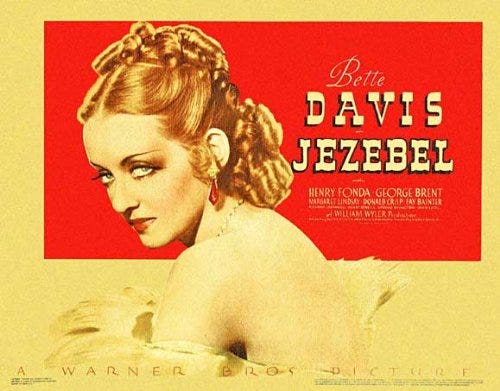
I decided to watch the 1938 film Jezebel after the title caught my eye—and truly, those big round eyes of the lead actress staring back at me summoned me to take a closer look. It’s a pity the song went through my head right away. “Bette Davis Eyes,” the Kim Carnes version that became a huge hit in the 1980s. Then came the sorting. Which came first? Getting to know an actor for their work or the tune that attaches to a name like glue? Popular culture has a way of scrambling the order.
But nevertheless, I pressed play.
Almost immediately I was nearly repulsed and started to turn it off.
Let me say more about the film itself.
Jezebel is a 1938 American romantic drama directed by William Wyler. The film stars Bette Davis as Julie Marsden, a headstrong Southern belle in 1852 New Orleans, and Henry Fonda as her fiancé, Preston "Pres" Dillard. Julie’s willful behavior, notably her decision to wear a scandalous red dress to a high-society ball, strains her relationship with Pres and leads to significant personal consequences. The narrative explores themes of pride, societal expectations, and redemption against the backdrop of the antebellum South.
(It’s not southern pride that turned me off. That’s second nature to me.)
Upon its release in 1938, Jezebel received critical acclaim, particularly for Bette Davis's portrayal of Julie Marsden, which earned her a second Academy Award for Best Actress. However, contemporary audiences may find certain aspects of the film challenging. The depiction of slavery and the antebellum South can be unsettling, as the film portrays enslaved individuals in a manner that lacks direct sympathy, reflecting the era's racial prejudices. Additionally, some viewers might find the character of Julie Marsden, with her manipulative and self-centered behavior, difficult to empathize with, leading to a sense of detachment from her narrative arc. Furthermore, the film's pacing and plot development have been critiqued for lacking depth and plausibility, which can affect viewer engagement. These elements combined may contribute to an initial impulse to disengage from the film.
And yet—I kept watching. Maybe it was the pop song still looping in my mind, or maybe it was the eyes again, less sultry now, more uncertain. Kim Carnes had warned me they’d "haunt you," and maybe she was right. There’s a moment when the performance shifts—when all that theatrical flair folds inward. And something real, or at least really human, starts to show. Jezebel turns out to be a film not just about vanity or defiance, but about what it means to face yourself. Redemption here isn’t a grand victory. It’s more like a quiet bet against the ugliness of the world. That maybe we can still come back from ourselves, even if we can’t undo the damage.
It’s strange, watching a film like Jezebel during a time of such visible strain in the world—political divides, cultural reckonings, the kind of public unraveling that makes it hard to know what to believe or where to look. You start to wonder if the only place to begin is inward. In a world of entrenched customs and personal vanity, what does it mean to make a humbling gesture that isn’t guaranteed to work? There’s something timeless—and quietly radical—in that. And maybe that’s the challenge we all face, especially when things feel unsteady: to reckon with ourselves first. To risk the discomfort of seeing our own complicity, or pride, or fear, and then to choose—despite it—to move toward something better. It’s not grand. It’s not guaranteed. But it is, sometimes, just enough to start.
I didn’t expect all that from a black-and-white melodrama with hoop skirts and duels at dawn. I just wanted to see what those Bette Davis eyes were really about. Turns out, they’re not just for arch looks and dramatic stares—they’re about staying with what’s in front of you when it counts. Which, come to think of it, might be the hardest thing any of us can do. Anyway, I let the film finish. And then, without really meaning to, I watched that final scene again.
Some things you have to see twice.