
The Idle Class
A review of the Charlie Chaplin film (1921)

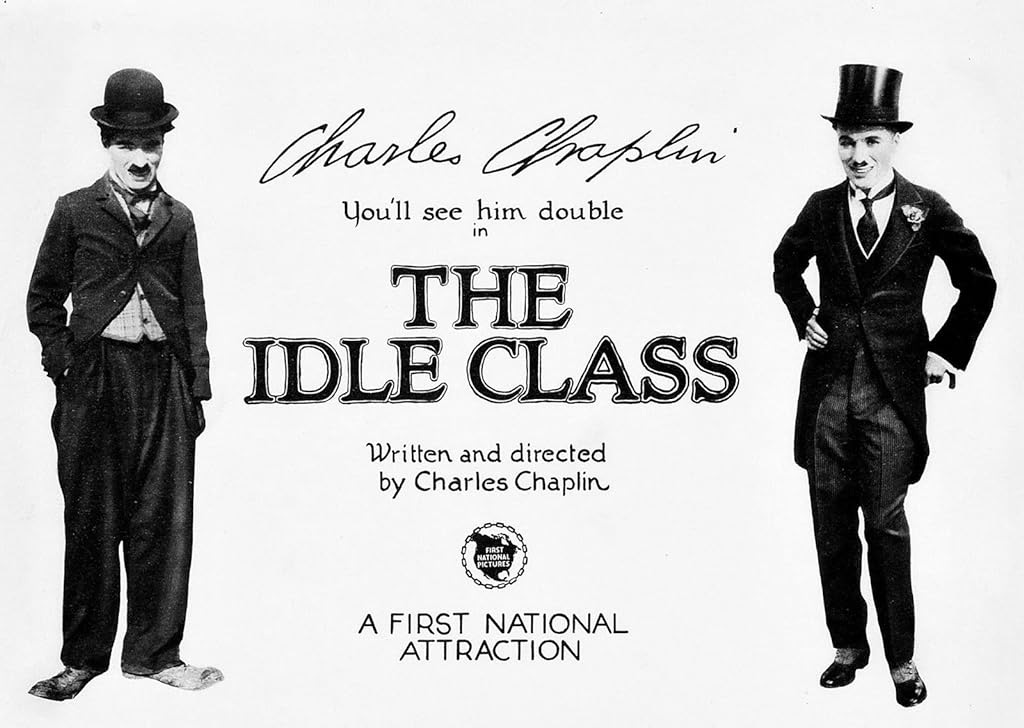
A rags to riches tale almost always evokes the story of the underdog, but no one does this better than Charlie Chaplin who had the lived experience of poverty before becoming a wealthy Hollywood A-lister. Charlie Chaplin wrote, directed, and starred in many films including The Idle Class (1921) where he played dual roles as both the iconic Tramp and an absent-minded husband. In The Idle Class, he toys with comingling of classes as a vagabond bound for the country club seeks to relish in the idle lifestyle of the rich.
The short film begins at a railway station where affluent travelers arrive for summer vacation at the hotel of a golf resort. After the train stops, a side panel opens and out pops the Tramp who scampers down the platform carrying golf clubs in a burlap sack. The Tramp is soon on his way again as a stowaway to the resort. This time catching a ride on the back of a limousine of a woman who’s married to his lookalike, the absent minded husband.
The antics that follow show Chaplin’s mastery of the comedic scene — whether playing through on the golf course with improbable good fortune or waltzing about in the hotel lobby as the absent minded husband who forgot his pants. It’s not zany; it’s carefully-crafted, well-orchestrated humor, set in motion by the Tramp meandering through the privileged life of the rich, as if it were his birthright.
Chaplin’s talent was noted at an early age as a boy on stage when he played a small role in Sherlock Holmes (1899) before joining the Fred Karno theatrical troupe. As a result of his legendary career, it’s easy to brush over his early experiences as incidental facts of childhood on the way to a much larger career. But, in reality, it was child labor in order not to starve.
His parents had split up, and with his mother in and out of an asylum, he and his brother were passed between residential schools, workhouses, relatives, or the street. By age 10, he caught a break in the recurring role in Sherlock Holmes, which gave him regular work and ultimately the exposure that would lead to his global celebrity through film.
Chaplin had his bouts with melancholia, which I can understand, stemming from episodes of childhood trauma. These experiences are hard to grow out of, even given Chaplin’s immense wealth and fame and social capital. (Apparently, even Stalin was a Chaplin fan?) He co-founded United Artists and at 26 years old was one of the highest paid people in the world. Yet at times it was hard to create. And he made mistakes in personal relationships. I can understand.
When The Idle Class was released, only three years had passed since the end of World War I, which employed devastating new technologies like chemical weapons that led to mass causalities. Not only did Chaplin understand suffering in childhood, but he witnessed the effects of the deadliest and most destructive war in history. Traumatic experiences can take a toll on both individuals and society.
Perhaps that’s why Chaplin, who had been perfecting the Tramp since the outbreak of war in 1914, made the Tramp a mainstay in his films. And perhaps that’s why audiences ravenously adored Chaplin who provided comedic relief in his cheeky undermining of the wealthy class while the mass population was suffering.
Later he would say, “The saddest thing I can imagine is to get used to luxury.”
The saddest thing I can imagine is to get used to luxury.
What is it about his character the Tramp?
In the last scene of The Idle Class, the Tramp has his moment of triumph despite the rich people kicking him out of the golf resort. In the end, the have’s have, and the have not’s, don’t. So, what was the victory?
I think the Tramp showed us a sort of success even while being defeated. If suffering was senseless to Chaplin, then the Tramp showed us a manner of living with resilience. He provided an image of masculine vulnerability — those eyes, that expression — coupled with an irreverent detachment that wasn’t cruel. Chaplin embodied a sense of play in his performances that translated from the screen to the heart.
Interesting. And really well-written.